Joule and the Future of SAP: From Assistant to Agents
Where SAP is taking Joule after Sapphire 2026, what it means for S/4HANA projects, and which skills developers should invest in now.
When Joule was announced in 2023, it looked like a chat window on top of SAP applications. Three years later SAP talks about the "autonomous enterprise", and Joule has become the front door to a whole layer of assistants and AI agents. In this post I summarise where things stand, how I read the direction, and what it means for us as SAP developers and consultants.
The figures below come from SAP's own announcements and press coverage of Sapphire 2026. Product names and availability change fast — always check SAP's current roadmap before planning a project.
From copilot to agents
The evolution in three steps:
- Copilot (2023–2024): Joule answers questions, navigates apps and summarises data.
- Assistants and agents (2025): Joule is repositioned as an agentic platform. Agents can carry out multi-step tasks across processes — for example dispute resolution or receivables follow-up.
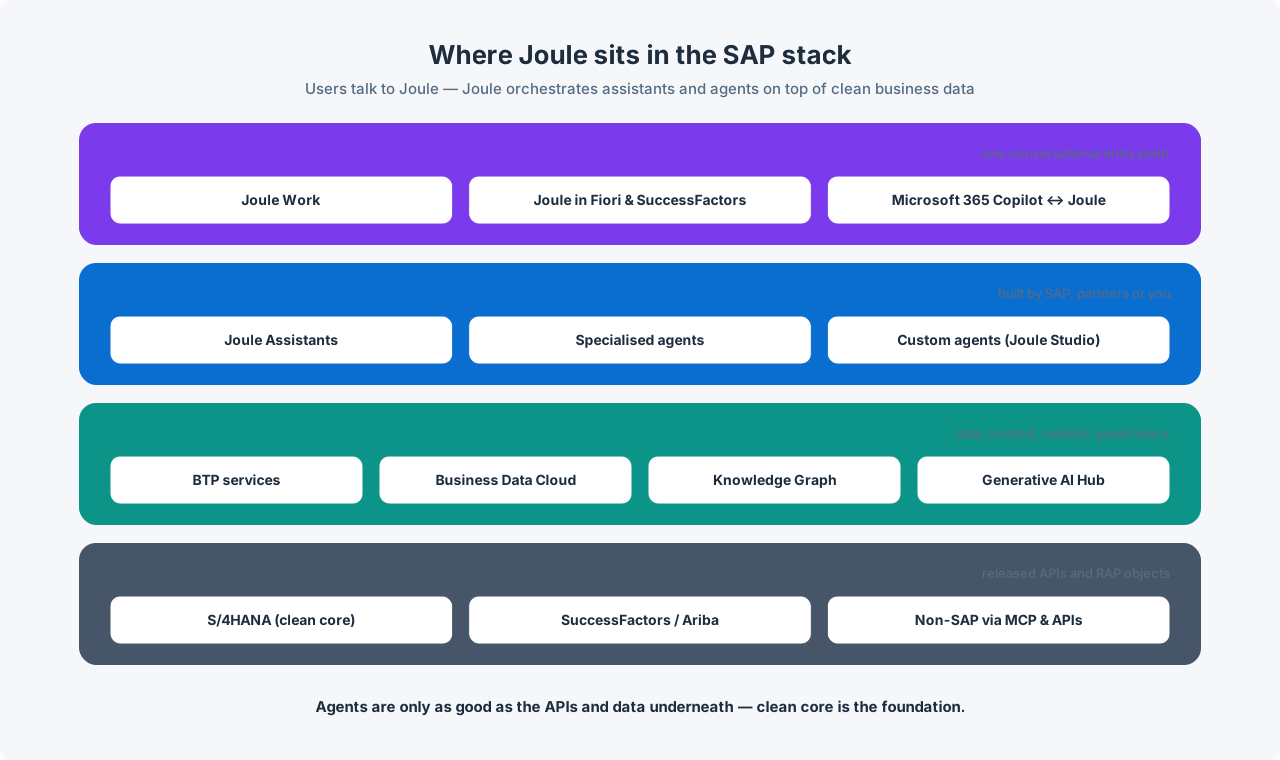
- Autonomous enterprise (2026): At Sapphire 2026 SAP presented Joule Work as a single AI workspace, announced more than 50 Joule Assistants and over 200 specialised agents, and merged BTP, Business Data Cloud and Business AI into the SAP Business AI Platform.
What is really new
- Joule Studio — SAP's environment for building your own agents. Agents run on a managed runtime and can keep context across sessions.
- Business context — a Knowledge Graph gives agents the meaning of SAP objects: what a sales order is, how it relates to deliveries and invoices.
- Openness — agents can call non-SAP tools via MCP, and there is agent-to-agent integration with Microsoft 365 Copilot. SAP also mentions support for external coding tools such as Cursor and Claude Code.
- SAP-specific models — SAP is training models that understand ABAP, RAP and CDS, instead of relying only on general-purpose LLMs.
What it means for S/4HANA projects
My honest take: agents are only as good as the APIs and data underneath them. An agent that wants to approve a purchase requisition needs a stable, released API with clear semantics and proper authorisations. That is exactly what clean core gives you:
- Released APIs and RAP business objects become the "tools" agents use. A well-designed RAP BO with validations and actions is directly usable by an agent — a Z-report with screen logic is not.
- Data quality matters more than ever. Duplicate customers or missing master data lead to confident but wrong answers.
- Authorisations must be thought through: an agent acts on behalf of a user, so roles have to be precise.
- Cloud first: most new agents target cloud deployments. On-premise and ECC customers increasingly reach them only through a modernisation path.
What I recommend developers learn now
- RAP and CDS, properly. Good semantics (annotations, associations, actions) are what make objects understandable to AI.
- BTP basics: destinations, XSUAA, CAP — agents and extensions live there.
- MCP and tool design. I already use the MCP server of ADT for VS Code to let an AI assistant read ABAP objects safely — read-only, with an allowlist. That is a good first step.
- Prompt and agent design: clear instructions, small well-defined tools, human approval for anything that changes data.
Risks worth keeping in mind
- Licensing and cost are still moving targets; promotions do not last forever.
- Governance: who approves what an agent does, and how is it audited?
- Expectations: a demo is not a production process. Start with narrow, measurable use cases.
Conclusion
Joule is no longer "a chatbot in Fiori". It is becoming the way users will interact with SAP — and agents will increasingly do the routine work. For us this is good news: clean, well-modelled backend objects are exactly what this future runs on. The better our RAP objects and APIs, the more useful Joule becomes.
Sources
- SAP News – New Joule Studio for enterprise-scale agentic development
- SAP – Top 5 Sapphire 2026 AI announcements
- Techzine – SAP launches the autonomous enterprise at Sapphire 2026
- Computer Weekly – Sapphire 2026: route change on the road to business AI
- ERP Today – SAP TechEd 2026: what's rolling out through 2027
Comments